- SA 520 covers analytical procedures used as substantive procedures and those performed near the end of the audit; analytical procedures for risk assessment are in SA 315.
- The near-the-end analytical review is required in every audit (paragraph 6). Substantive analytical procedures are a choice, but when used they must meet paragraph 5.
- When analytical procedures are used as substantive procedures, paragraph 5 requires a sufficiently precise expectation and a set amount of acceptable difference. Whenever analytical procedures show significant unexplained differences, paragraph 7 requires investigation — management enquiry plus evidence.
- Schedule III (Division I) requires eleven ratios in the notes, with an explanation for any change of more than 25% — your CY vs PY review should cover them.
- Document the expectation, threshold, differences, explanations, evidence and conclusion (SA 230).
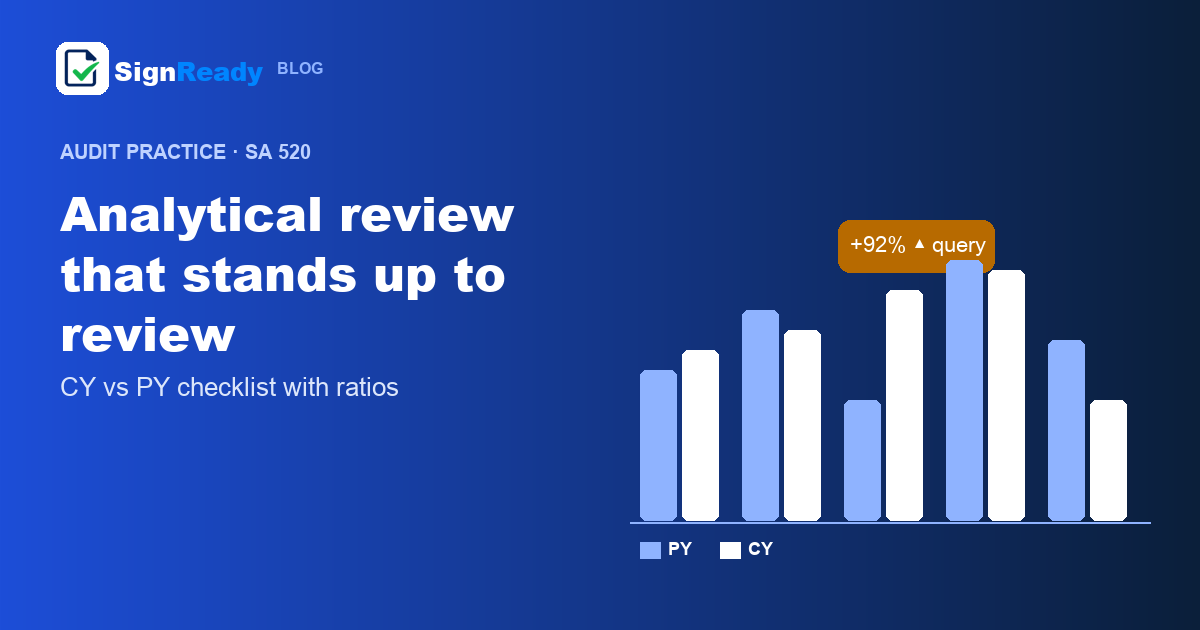
Most finalisation files have a "CY vs PY" sheet. Far fewer have an analytical review that would satisfy SA 520 — one with an expectation, a threshold, an investigation and a conclusion. This guide sets out what the standard actually requires and a routine that a small firm can run on every file.
What SA 520 actually requires
SA 520, Analytical Procedures, defines analytical procedures as evaluations of financial information through analysis of plausible relationships among both financial and non-financial data, including the investigation needed when fluctuations or relationships are inconsistent with other information or differ from expected values by a significant amount.
| Paragraph | Requirement (summarised) |
|---|---|
| 5 — Substantive analytical procedures | When you use them, (a) decide whether the procedure suits the assertion, given the assessed risks; (b) evaluate the reliability of the data used to build the expectation; (c) develop an expectation precise enough to identify a material misstatement; and (d) decide the amount of difference from the expectation that is acceptable without further investigation. |
| 6 — Near the end of the audit | Design and perform analytical procedures near the end of the audit that help you form an overall conclusion on whether the financial statements are consistent with your understanding of the entity. |
| 7 — Investigating results | Where fluctuations or relationships are inconsistent or differ significantly from expected values, investigate by enquiring of management and obtaining appropriate audit evidence for their responses, and by performing other procedures as needed. |
Three points are often missed. First, paragraph 6 is a "shall" for every audit — the near-the-end analytical procedures are not optional. Second, the detailed requirements in paragraph 5 (expectation, precision, acceptable difference) apply when you choose to use analytical procedures as substantive procedures; the routine below follows them because they make any review sharper, but a paragraph 6 review is designed for the overall conclusion rather than as evidence for a specific assertion. Third, a management explanation on its own is not enough under paragraph 7: the response has to be corroborated with evidence.
An eight-step CY vs PY routine
- Get comparable data. Take the final TB for both years and map ledgers to the same Schedule III heads. Where a ledger has been renamed or regrouped, align it before comparing — otherwise the "movement" is only a reclassification.
- Set the threshold. For substantive analytical procedures, paragraph 5(d) requires you to decide the difference that is acceptable without further investigation — a matter of judgement that depends on materiality, the assessed risk and the assurance you want. Many firms start from performance materiality under SA 320 and add a percentage filter — for example, movements that exceed performance materiality and 10–20% of the prior-year balance. Document the method and apply it consistently, tailoring the threshold to each engagement's risks and materiality.
- Build expectations before you look. Estimate what the balance should be: salaries from headcount and increments; depreciation from opening carrying amounts, additions and disposals, and the company's depreciation method, useful lives and residual values; interest from the average loan and rate; rent from the agreements; revenue from volumes and prices where known.
- Compare and list. Note every head where the recorded amount differs from the expectation (or from last year) by more than the threshold. Also list new ledgers, ledgers that have become nil, and balances on the "wrong" side — a debit balance in creditors, a credit balance in debtors.
- Compute ratios. Use the table below — the change in a ratio often points to the problem more clearly than the change in a single balance.
- Investigate. Ask management for the reason, then corroborate it — invoices, agreements, bank statements, stock records, board minutes.
- Conclude. Decide whether each difference is explained, is a misstatement to be corrected, or needs further testing.
- Update it near the end. Near the end of the audit, perform or update the analytical procedures on the final or revised financial information as needed, so that they help you form the overall conclusion required by paragraph 6.
Upload this year's and last year's TB: SignReady maps the ledgers, flags the material movements against your materiality, calculates the key ratios and turns the points into client queries.
Ratios worth computing from a trial balance
| Ratio | How to compute | What a change can signal |
|---|---|---|
| Gross margin | (Revenue − cost of goods sold) ÷ revenue, with cost of goods sold defined consistently for the entity — for example, materials consumed or purchases, the change in inventories and directly attributable production or trading costs | Cut-off errors, unrecorded purchases, inventory valuation, pricing changes |
| Net profit ratio | Net profit ÷ revenue | Unrecorded expenses or provisions; one-off items |
| Trade receivables days | Trade receivables ÷ revenue × 365 | Collection problems, doubtful debts, fictitious or pre-dated sales |
| Trade payables days | Trade payables ÷ purchases × 365 | Unrecorded liabilities, MSME payment delays |
| Inventory days | Inventory ÷ cost of goods sold × 365 | Slow-moving or obsolete stock, overstatement |
| Current ratio | Current assets ÷ current liabilities | Liquidity strain, misclassification between current and non-current |
| Debt-equity | Borrowings ÷ shareholders' funds | Covenant pressure, going-concern indicators |
| Employee cost to revenue | Employee benefits expense ÷ revenue | Missing provisions (gratuity, leave encashment, bonus), payroll errors |
The "days" ratios above use year-end balances, so treat them as indicators; for performance analysis, use average balances and credit sales, relevant purchases or cost of goods sold as appropriate. These are audit analytics, not the Schedule III formulae.
Schedule III ratios. For companies following Schedule III, Division I, the "Additional Regulatory Information" requires eleven ratios in the notes: current ratio, debt-equity, debt service coverage, return on equity, inventory turnover, trade receivables turnover, trade payables turnover, net capital turnover, net profit ratio, return on capital employed and return on investment. The company must explain the items in each numerator and denominator, and give an explanation for any change of more than 25% compared with the preceding year. Your analytical review is the natural place to test those explanations before they go into the notes.
A short worked example
| Item | FY 2024-25 | FY 2025-26 | Change |
|---|---|---|---|
| Revenue | ₹12.0 crore | ₹14.4 crore | +20% |
| Gross margin | 28% | 22% | −6 points |
| Trade receivables days | 45 | 78 | +33 days |
| Employee cost | ₹1.10 crore | ₹1.12 crore | +2% |
Revenue is up 20% but the margin has fallen six points and receivables days have risen by 33 days (73%). Questions for the client: were there large sales in March (cut-off, and whether goods were actually dispatched)? Were prices cut, or purchases booked in advance? Why has collection slowed — any disputed customers? And with revenue up 20%, why has employee cost barely moved — has the gratuity or bonus provision been made? Each answer then needs evidence: dispatch records, credit notes, customer ledgers after the year end, actuarial or provision workings.
Documenting the review
SA 230 requires documentation sufficient for an experienced auditor with no previous connection with the audit to understand the procedures, the evidence and the conclusions. A practical checklist for analytical procedures:
- the data used and why it is reliable (for example, the final TB, reconciled to the books);
- the expectation for each head tested and how it was built;
- the threshold and how it links to materiality;
- the differences found, management's explanations and the evidence obtained;
- the conclusion — and, for the final review, the date and the version of the financial statements it covered.
Frequently asked questions
Is analytical review mandatory in every audit?
Yes, near the end of the audit. Paragraph 6 of SA 520 requires analytical procedures that help form an overall conclusion on whether the financial statements are consistent with the auditor's understanding of the entity. Using analytical procedures as substantive procedures is a choice; when you do, paragraph 5 applies.
Does SA 520 prescribe a percentage threshold for investigation?
No. For substantive analytical procedures, paragraph 5(d) requires the auditor to determine the amount of difference that is acceptable without further investigation; the amount is a matter of judgement, depending on materiality, risk and the assurance sought. Starting from performance materiality under SA 320 keeps the method consistent across files.
Is management's explanation enough to close a variance?
No. Paragraph 7 requires enquiry of management and appropriate audit evidence relevant to management's responses, plus other procedures where needed.
Which ratios must a company disclose under Schedule III?
Division I lists eleven: current ratio, debt-equity, debt service coverage, return on equity, inventory turnover, trade receivables turnover, trade payables turnover, net capital turnover, net profit ratio, return on capital employed and return on investment — with the items in the numerator and denominator explained, and an explanation for any change of more than 25% over the preceding year.
Sources
- ICAI — SA 520, Analytical Procedures (Board of Studies material reproducing the standard)
- ICAI — SA 230 Audit Documentation; SA 315 Identifying and Assessing the Risks of Material Misstatement; SA 320 Materiality in Planning and Performing an Audit
- Companies Act, 2013 — Schedule III, Division I, Part I, Additional Regulatory Information, item (xii) Ratios (India Code)
SignReady drafts the CY vs PY analysis, ratios, review points and an Analytical Review Note (PDF / Word) for your team to complete with evidence, conclusions and partner review — first 3 finalisations free.
Version history: 2 Oct 2026 — first published.