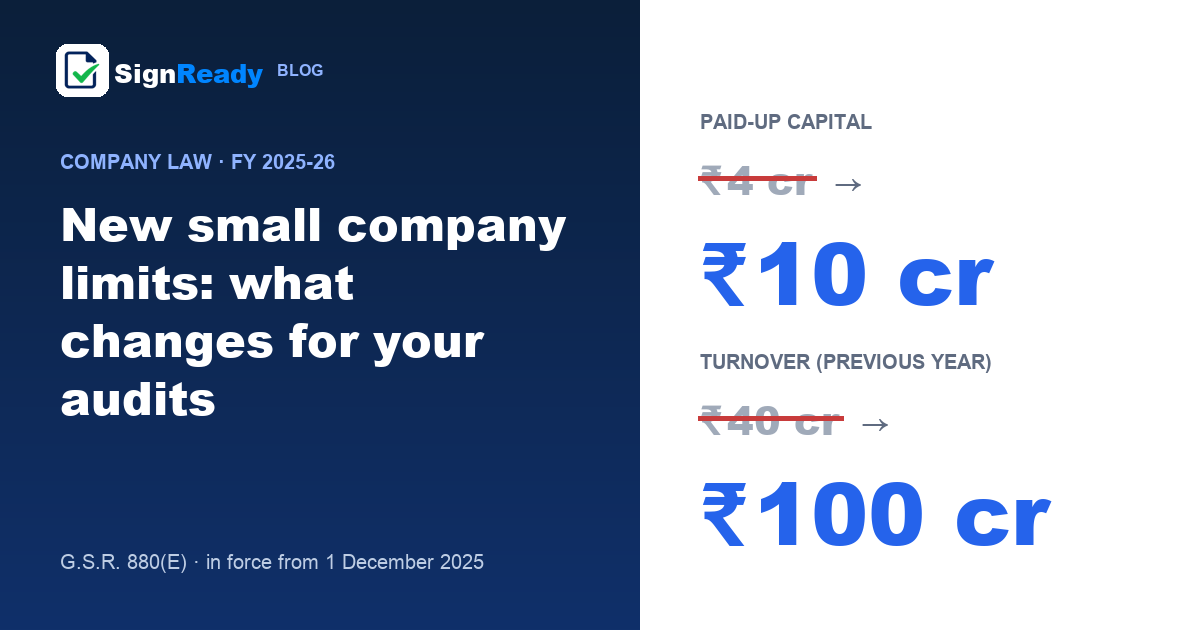
- From 1 December 2025, G.S.R. 880(E) raised the small company limits to ₹10 crore paid-up capital and ₹100 crore turnover (earlier ₹4 crore and ₹40 crore).
- A company must meet both limits, must be a private company, and must not be a holding or subsidiary company, a section 8 company or a company governed by a special Act.
- Turnover is tested on the profit and loss account of the immediately preceding financial year — for FY 2025-26, that is FY 2024-25.
- If a company is a small company, CARO 2020 does not apply, the cash flow statement may be left out, and the auditor does not report on internal financial controls (subject to the ROC-filing condition).
- A small company is not the same as an SMC under the Accounting Standards Rules — that test uses different limits.
On 1 December 2025 the Ministry of Corporate Affairs notified G.S.R. 880(E), the Companies (Specification of definition details) Amendment Rules, 2025. It substitutes clause (t) of rule 2(1) of the 2014 Rules so that the paid-up capital and turnover of a small company "shall not exceed rupees ten crores and rupees one hundred crores respectively". The rules came into force on the date of their publication in the Official Gazette — 1 December 2025.
The previous limits, set in September 2022 by G.S.R. 700(E), were ₹4 crore and ₹40 crore. Many private companies that were outside the definition last year now fall inside it — and that changes what the auditor reports on in FY 2025-26.
What the small company definition says now
Section 2(85) of the Companies Act, 2013 defines a small company as a company, other than a public company, whose paid-up share capital does not exceed the prescribed amount and whose turnover, as per the profit and loss account for the immediately preceding financial year, does not exceed the prescribed amount. The Act caps what can be prescribed at ₹10 crore and ₹100 crore — the new rule uses the full headroom.
| Test | Condition | How to read it for an FY 2025-26 audit |
|---|---|---|
| Type of company | Not a public company | Only a private company (including an OPC) can be a small company. |
| Paid-up share capital | Not more than ₹10 crore | ICAI's Guidance Note on CARO 2020 applies the Order on the company's status at the balance sheet date, so take paid-up capital as at 31 March 2026. |
| Turnover | Not more than ₹100 crore, as per the P&L of the immediately preceding financial year | Use the turnover in the profit and loss account for FY 2024-25. |
| Exclusions (proviso) | Not a holding or subsidiary company, not a section 8 company, not governed by a special Act | A holding or subsidiary company is never a small company, however small it is. |
Both money limits must be met together — the definition joins them with "and". "Turnover" is defined in section 2(91) as the gross amount of revenue recognised in the profit and loss account from the sale, supply or distribution of goods or on account of services rendered, or both.
Do the new limits apply to FY 2025-26 audits?
The amendment took effect on 1 December 2025, before the FY 2025-26 balance sheet date of 31 March 2026. ICAI's Guidance Note on CARO 2020 (Revised 2022 edition, paragraph 12) says the applicability of the Order is based on the company's status as at the balance sheet date, and asks auditors to refer to the notifications relevant to the year under audit for changes to the small company thresholds. On that basis, the ₹10 crore / ₹100 crore limits are the ones to test for FY 2025-26 financial statements.
Keep a note of the figures you used (paid-up capital at 31 March 2026 and FY 2024-25 turnover) in the working papers, because the answer can change from one year to the next.
What changes for the audit report and the financial statements
| Area | If the company is a small company | Where it comes from |
|---|---|---|
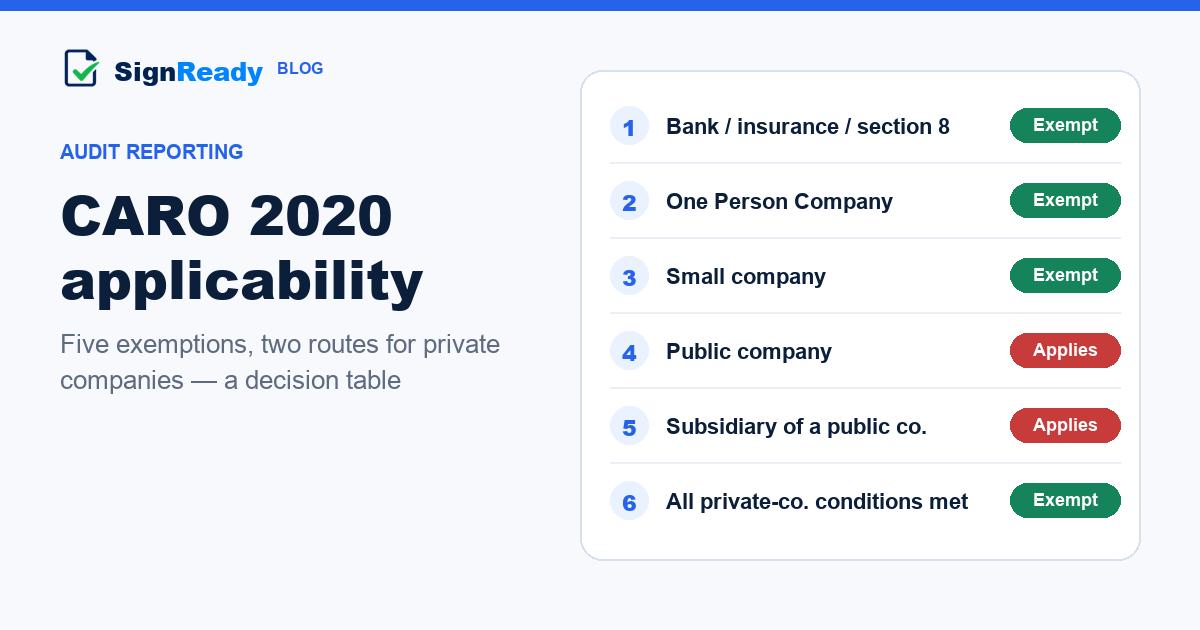
| CARO 2020 | The Order does not apply. | CARO 2020, paragraph 1(2)(iv) — "a One Person Company … and a small company as defined in clause (85) of section 2" |
| Cash flow statement | The financial statements may leave it out. | Proviso to section 2(40) |
| Internal financial controls (section 143(3)(i)) | The auditor's report need not report on internal financial controls with reference to financial statements — provided the company has not defaulted in filing its financial statements (section 137) or annual return (section 92) with the Registrar. | Notification G.S.R. 583(E) dated 13 June 2017 (exemptions to private companies under section 462) |
Everything else in the audit report stays: the opinion paragraphs, the matters under section 143(3) other than internal financial controls, and the Rule 11 statements of the Companies (Audit and Auditors) Rules, 2014.
Note that the same 2017 notification also exempts from internal financial controls reporting a private company whose turnover in its latest audited financial statements is below ₹50 crore, or whose aggregate borrowings from banks, financial institutions and bodies corporate are below ₹25 crore at all times during the year. The filing condition applies to every route: the exemption is available only if the company has not defaulted in filing its financial statements under section 137 or its annual return under section 92. Some of the newly "small" companies were already outside IFC reporting through the turnover or borrowing route — for them, the real change is CARO and the cash flow statement.
SignReady reads paid-up capital and last year's turnover from the trial balances and asks the questions a TB cannot answer — company type, group links, section 8, ROC filings. It then shows the likely effect on CARO, cash flow and IFC reporting for your review.
A small company is not an SMC
For companies that follow the Accounting Standards (not Ind AS), the Companies (Accounting Standards) Rules, 2021 have their own category — the Small and Medium-sized Company (SMC) — that decides which relaxations in the Accounting Standards are available. Its tests are different: among other conditions, turnover (excluding other income) of not more than ₹250 crore and borrowings (including public deposits) of not more than ₹50 crore at any time during the immediately preceding accounting year, and it is not limited to private companies. The conditions are tested as at the end of the relevant accounting period. A company can be an SMC without being a small company, and the other way round. Test the two separately and record both conclusions.
Four worked examples
| Company | Facts (FY 2025-26 audit) | Small company? | Effect |
|---|---|---|---|
| A | Private, no holding or subsidiary relationship. Paid-up capital ₹8 crore at 31 March 2026; FY 2024-25 turnover ₹90 crore. | Yes — it was not under the old ₹4 crore / ₹40 crore limits. | CARO does not apply; the cash flow statement may be left out; no IFC reporting if its ROC filings are up to date. |
| B | Private (not an OPC), standalone. Paid-up capital ₹12 crore; FY 2024-25 turnover ₹60 crore. | No — capital is above ₹10 crore. | Test CARO through the separate private-company exemption — with ₹12 crore of capital it fails the ₹1 crore capital-and-reserves condition, so CARO applies unless another exemption (bank, insurer, section 8) fits. Cash flow statement required unless it is dormant. IFC: turnover is above ₹50 crore, so it is exempt only if its borrowings from banks, financial institutions and bodies corporate stayed below ₹25 crore at all times during the year — and only if its ROC filings are up to date. |
| C | Private, wholly owned by a Singapore company. Paid-up capital ₹2 crore; FY 2024-25 turnover ₹30 crore. | No — it is a subsidiary company. | Not small, whatever its size. CARO, cash flow and IFC must each be tested on their own conditions. |
| D | Unlisted public company. Paid-up capital ₹1 crore; turnover ₹5 crore. | No — a public company is never a small company. | CARO applies unless it is a banking, insurance or section 8 company — the private-company exemption is not available to a public company. Cash flow statement required unless it is a dormant company. IFC reporting applies — the 2017 exemption is only for private companies. |
Checklist for your FY 2025-26 files
- Confirm the company type (private / public / OPC) from the master data and the certificate of incorporation.
- Confirm whether it is a holding or subsidiary company — including control by a foreign body corporate — or a section 8 company, or governed by a special Act.
- Take paid-up share capital as at 31 March 2026 from the TB and the share capital note.
- Take turnover from the FY 2024-25 profit and loss account (revenue from operations, not other income).
- Conclude on small company status and record the figures and the date of the test.
- If the status has changed from last year, revisit CARO, the cash flow statement and IFC reporting, and tell the client early — the financial statements and the audit report may both change.
- Test SMC status for the Accounting Standards separately.
Frequently asked questions
Must a company meet both limits to be a small company?
Yes. Section 2(85) joins the paid-up capital test and the turnover test with "and", so both must be met. The company must also be a private company that is not a holding or subsidiary company, a section 8 company or a company governed by a special Act.
Which year's turnover is used for FY 2025-26?
The turnover as per the profit and loss account of the immediately preceding financial year — FY 2024-25 for the FY 2025-26 financial statements.
Can a subsidiary of a foreign company be a small company?
No. For the definitions of holding and subsidiary company, the Act says "company" includes any body corporate, so a company controlled by a foreign parent is a subsidiary company — and the proviso to section 2(85) excludes subsidiary companies.
If a company becomes a small company, must it drop the cash flow statement?
No. The proviso to section 2(40) says the financial statements of a small company may not include the cash flow statement. It is a relaxation, not a prohibition — the company can still present one.
Does small company status settle which Accounting Standards relaxations apply?
No. The Accounting Standards use the separate SMC test in the Companies (Accounting Standards) Rules, 2021, with its own turnover and borrowing limits. Test it separately.
Sources
- G.S.R. 880(E) dated 1 December 2025 — Companies (Specification of definition details) Amendment Rules, 2025 (Gazette of India)
- Companies Act, 2013 — sections 2(40), 2(46), 2(85), 2(87), 2(91), 143(3)(i) (India Code)
- Companies (Auditor's Report) Order, 2020 — S.O. 849(E) dated 25 February 2020 (full text in Appendix I of ICAI's Guidance Note, Revised 2022, hosted by CAG)
- ICAI, Guidance Note on the Companies (Auditor's Report) Order, 2020 (Revised 2022 edition), paragraphs 11–14
- Notification G.S.R. 583(E) dated 13 June 2017 — exemptions to private companies under section 462 (MCA)
- Companies (Accounting Standards) Rules, 2021 — rule 2(1)(e), Small and Medium-sized Company
SignReady assists the small company, CARO, cash flow and IFC assessment from the TB and your answers, with the reason shown for the engagement team to confirm — first 3 finalisations free.
Version history: 1 Oct 2026 — first published.